 |
Welcome To Evlithium Best Store For Lithium Iron Phosphate (LiFePO4) Battery |
 |
For anyone relying on portable power, from flashlights and laptops to electric vehicles and solar generators, the 18650 battery is a ubiquitous workhorse. But its performance hinges on one critical metric: capacity. Understanding what 18650 capacity means, how it's measured, and what the realistic maximums are is essential for making informed decisions and avoiding fraudulent products. This comprehensive guide will demystify 18650 battery capacity and reveal the true state of the art as we look toward 2025.
At its core, the capacity of an 18650 battery signifies the total amount of electrical energy it can store. We measure this energy in milliampere-hours, abbreviated as mAh. This unit provides a direct indication of how long the battery can power a device before requiring a recharge.
Think of mAh as the size of your battery's fuel tank. A larger tank (higher mAh) means you can drive longer before needing to refuel.
A Practical Example of mAh:
A 3500mAh 18650 battery can theoretically deliver:
3500 mA (or 3.5A) for 1 hour.
1750 mA (or 1.75A) for 2 hours.
500 mA (or 0.5A) for 7 hours.
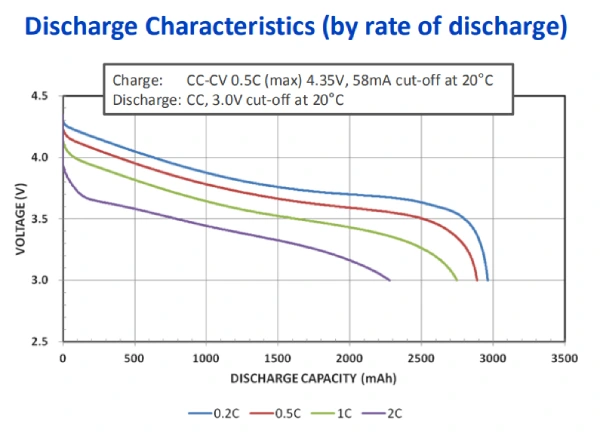
It's crucial to remember that real-world performance often differs from these theoretical values due to factors like discharge rate and temperature. Higher drain devices will reduce the effective capacity.
You should never trust faded labels or dubious vendor claims. To know the true capacity of an 18650 cell, you must test it yourself. Here is a reliable method using a dedicated battery capacity tester, which is more accurate than a simple multimeter for this purpose.
Safety First & Identification: Ensure you are handling a genuine 18650 lithium-ion battery. Work in a safe, non-flammable area and consider using a protective battery case.
Fully Charge the Battery: Place the battery in a quality lithium-ion charger until it reaches its full voltage, typically 4.2V for most chemistries.
Use a Dedicated Capacity Tester: These affordable devices are designed for this exact purpose. Connect the battery to the tester.
Set a Discharge Parameter: Program the tester to discharge the battery at a standard rate (often 0.5C, e.g., 1.75A for a 3500mAh cell) down to the standard cutoff voltage, which is usually 2.5V - 3.0V to prevent damage.
Run the Test and Record Results: The tester will automatically drain the battery and display the actual capacity in mAh once the process is complete. Compare this result to the manufacturer's specification to gauge health.
The 18650 format is not a single battery type but a size specification (18mm x 65mm). Within this cylinder, different chemical compositions yield vastly different performance characteristics, directly impacting capacity.
Lithium Cobalt Oxide (LiCoO₂ / LCO): Offers the highest energy density, with capacities ranging from 2000mAh to 3600mAh. Best for low-drain applications like laptops and flashlights but has lower thermal stability. (e.g., Panasonic NCR18650B, LG MJ1).
Lithium Manganese Oxide (LiMn₂O₄ / LMO): Prioritizes power and safety over pure capacity, typically 1500–2200 mAh. Excels in high-drain applications like power tools. (e.g., Sony VTC series).
Lithium Nickel Manganese Cobalt Oxide (LiNiMnCoO₂ / NMC): The perfect balance. Provides good capacity (2500–3500 mAh), strong discharge rates, and decent lifespan. The go-to chemistry for e-bikes, EVs, and power tools. (e.g., Samsung 25R, LG HG2).
Lithium Iron Phosphate (LiFePO₄ / LFP): The safety champion. Lower capacity (1200–1500 mAh) and a different nominal voltage (3.2V), but offers exceptional cycle life (2000+) and incredible thermal stability. Ideal for solar storage and critical applications.
Lithium Nickel Cobalt Aluminum Oxide (LiNiCoAlO₂ / NCA): Similar to NMC, it provides very high capacity (3000–3600 mAh) and is used in premium applications like Tesla vehicles. (e.g., Panasonic NCR18650GA).
Your choice between a high-capacity and a standard or low-capacity cell depends entirely on your application.
High-Capacity 18650 Batteries (e.g., 3500mAh):
Pros: Maximizes runtime for medium-drain devices; ideal for flashlights, vaping mods, and portable electronics where longevity is key.
Cons: Typically has a lower continuous discharge rating (CDR); not suitable for high-drain devices; often more expensive.
Lower Capacity / High-Power 18650 Batteries (e.g., 2500mAh):
Pros: Designed to deliver high current (e.g., 20A-30A CDR); essential for power tools, high-performance vaping, and drones; generally more robust.
Cons: Shorter runtimes per charge; not optimal for devices that prioritize energy efficiency over power.
You must match the battery's CDR to your device's power demands. Using a high-capacity, low-CDR battery in a high-drain device is dangerous and can lead to overheating.
This is the central question for many users. As of mid-2025, the practical maximum capacity for a mass-produced, commercially available 18650 battery is 3600mAh.
Cells like the Panasonic NCR18650G, LG M36, and Samsung 36G have achieved this benchmark. It represents the current peak of the energy density vs. stability trade-off within the standard 3.6V/4.2V lithium-ion framework.
Beware of Exaggerated Claims:
Any vendor claiming an 18650 battery with a capacity significantly above 3600mAh (e.g., 4000mAh, 5000mAh, or 9800mAh) is selling a fake or dangerously overrated cell. These inflated numbers are physically impossible with current technology and are a clear sign of fraud. Similarly, be skeptical of any cell claiming both a massive capacity (e.g., 3600mAh+) and an extremely high CDR (e.g., 30A+); you usually must choose one or the other.
The race for capacity is led by the major Korean and Japanese manufacturers. Here are the three leaders for pure energy density:
Panasonic NCR18650G: The longstanding benchmark. Offers a true 3600mAh capacity but with a moderate continuous discharge current of 4.87A. The king of runtime for low to medium-drain applications.
LG INR18650-M36 (M36): Matches the 3600mAh capacity of the Panasonic but does so with a higher 10A continuous discharge rating, offering a better balance of capacity and power for more demanding devices.
Samsung INR18650-36G (36G): Another stellar 3600mAh cell with a 10A CDR, directly competing with the LG M36 and providing excellent all-around performance for users seeking maximum runtime.
Q: Do higher-capacity 18650 batteries last longer per charge?
A: Yes, absolutely. A higher mAh rating directly translates to longer runtime, provided the device's power draw is within the battery's discharge capabilities.
Q: Can I replace a lower-capacity battery with a higher-capacity one?
A: In most cases, yes, as long as the physical size is identical, the chemistry is compatible (e.g., both are standard 3.7V), and the new battery's CDR meets or exceeds the device's requirements.
Q: Are there any safety concerns with high-capacity 18650 batteries?
A: They carry the same risks as any other lithium-ion battery. They must be protected from physical damage, overcharging, and short circuits. Always purchase from reputable brands and vendors.
Q: How many charge cycles can a high-capacity 18650 battery handle?
A: A quality high-capacity cell from a major brand can typically endure 300 to 500 full charge cycles before its capacity degrades to about 80% of its original value.
Q: Is there a 4000mAh 18650 battery?
A: No, not as a standard, commercially available product. While laboratories may have prototypes, a reliable 4000mAh 18650 is not on the consumer market in 2025. Any product claiming this is fraudulent.
In conclusion, while the quest for higher energy density continues, the 3600mAh barrier remains the pinnacle of reliable 18650 technology as we move through 2025. By understanding capacity, chemistry, and your own device's needs, you can navigate the market effectively, avoid dangerous counterfeits, and select the perfect battery to power your projects safely and efficiently.
Edit by paco
Last Update:2025-09-19 09:46:40
All Rights reserved © 2026 Evlithium Limited